

For authors
Papers are submitted through the journal website. Your personal account shows the stage your paper is at; correspondence with the editorial office, reviews and revised versions are handled there too. Publication is free of charge.
How to submit a paper
- Register on the website — registration — and confirm your email using the link in the message. Only the submitting author needs an account; co-authors do not.
- Prepare the paper in the journal template (docx). The rules for text, formulas and figures are given in the template itself, for references — below. Papers not prepared in the template are not considered.
- Prepare scans (PDF or JPG): an expert opinion on the possibility of open publication stating the number of pages, tables and figures, and a cover letter from your organization with the contact details of the responsible person.
- Fill in the submission form in your personal account: section, language of the paper, UDC, title, authors and affiliations in Russian and English. The abstract, keywords and funding are taken from the paper file automatically.
The personal account is in Russian; the English fields of the form are labelled in English.
After submission
- Your account shows the stage of work: received, technical remarks, peer review, revision, accepted, in the publication queue, published. You receive an email about every change.
- Ask questions about your paper in its correspondence thread in your account; the editorial office replies there, and files can be attached.
- Peer review is blind: authors do not know the reviewer. The review is sent by the editorial office and appears in the paper's account page.
- If a revision is needed, upload the revised version in your account and describe the changes. If necessary, the paper goes to the reviewer again.
- Reviewer's remarks are usually placed in the manuscript itself as margin comments. Answer each of them in the same file with the Reply button of the comment (Word: Review tab; LibreOffice: right-click the comment) without deleting it, and upload this file as the revised version, so the reviewer can see what has been changed and how.
- An accepted paper gets its number in the issue and a DOI and is published on the website as soon as it is ready, without waiting for the whole issue.
Requirements
- The paper presents original, previously unpublished results and fits the scope of the journal. Reviews are commissioned by the editorial board.
- Papers are written in Russian or English, or in both. The title, abstract, keywords and references are given in both languages in any case.
- Structure: introduction (relevance, problem statement), main part with numbered sections, conclusion, funding.
- Abstract — about 250 words: aim, methods, main results. No formulas, references, new terms or abbreviations. The English abstract should not be a literal machine translation but coherent text in the style of scientific English: for international readers it is the main source of information about the paper.
- References — in the order of citation, mostly peer-reviewed articles and monographs; textbooks, dissertation abstracts and dissertations are better avoided. How to format them — below.
- Authors follow the principles of publication ethics.
How to format references
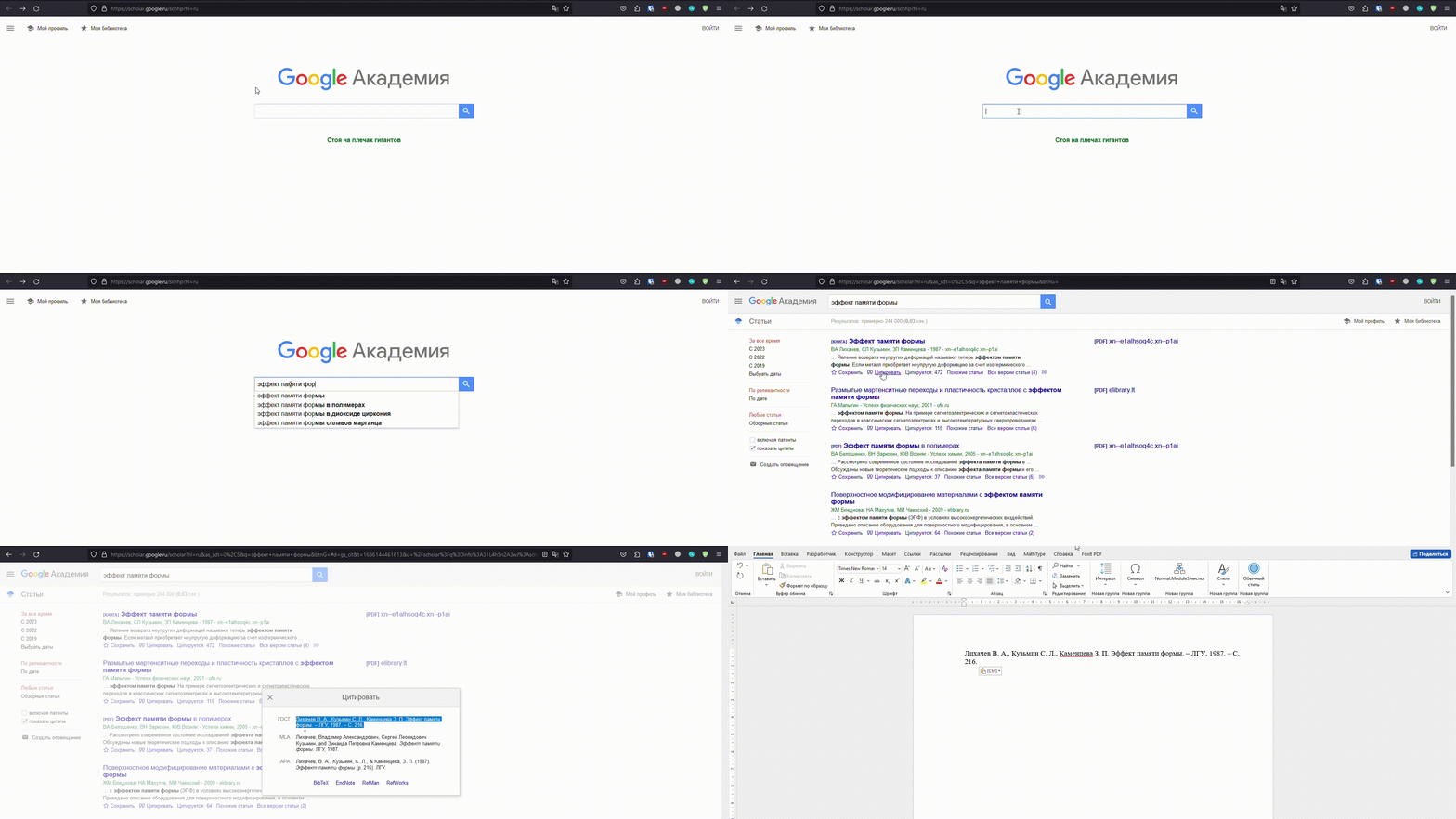
The easiest way is Google Scholar: find the source, click «Цитировать» (Cite) below it and copy the ГОСТ (GOST) format — it is available in the Russian-language interface. If the source has a DOI, add it at the end.
Or follow the sample. The template has two reference lists — in the Russian part of the paper and in the English part (References), with the sources in the same order. The Russian list gives the usual reference. The English list gives the same reference in English: authors' names and the names of journals and publishers transliterated according to BSI (unless the journal or publisher has its own English name), the title translated, and (In Russian) at the end. The mark is not needed if the work itself was published in English or has an English version.
Список литературы (Russian part of the paper):
- Лакс Б., Баттон К. Сверхвысокочастотные ферриты и ферримагнетики. – М.: Мир. 1965. – 675 с.
- Суслов Д.А., Щеглов В.И. Мультирежимный характер прецессии положения равновесия намагниченности в двухподрешеточном ферримагнетике с точкой компенсации // Журнал радиоэлектроники. – 2026. – № 8. https://doi.org/10.30898/1684-1719.2026.8.15
References (English part of the paper):
- Lacks B., Button C. Ultra high frequency ferrites and ferrimagnetics. – M: Mir. 1965. – 675 p. (In Russian)
- Suslov D.A., Shcheglov V.I. Multi-regime character of magnetization equilibrium position precession in two-sublattice ferromagnetic with compensation point // Journal of Radio Electronics. – 2026. – № 8. https://doi.org/10.30898/1684-1719.2026.8.15 (In Russian)
Terms of publication
- Publication is free of charge.
- Papers are published in open access under the Creative Commons BY-NC-ND 4.0 license; the copyright remains with the authors.
- All papers are peer reviewed.
Questions — in the paper's correspondence in your account or at journal@cplire.ru.